

Updated: 13 Aug 2026
Originally Published: 30 Apr 2024
What is a File Shredder?
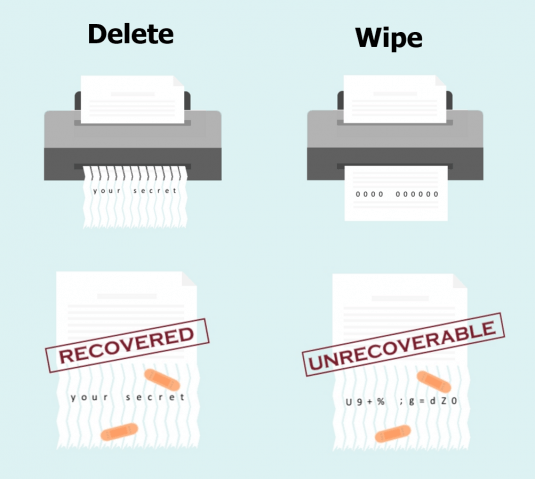
A file shredder is software that allows users to permanently delete files when no longer needed. This process is also known as wiping and consists in overwriting the space once occupied by the deleted file (or the file we aim to erase forever) by using zeros and ones.

When to Use a File Shredder?
For nearly a century, shredders have been the standard office tool for destroying documents. These tools effectively turn paper into confetti so that the sensitive information on a page is unreadable.
In the digital age, sensitive information is more likely to be stored in a document file than on a paper document. When the time comes to delete a piece of data, a file shredder tool like BCWipe can do an even more effective job than its office namesake.
Why You Need a File Shredder?
While the shredded strips of a paper document can be painstakingly reassembled, a properly shredded piece of data is destroyed beyond recovery.
Secure file shredding supports compliance efforts by ensuring sensitive information is irreversibly destroyed when no longer required.
ISO/IEC 27001 – Information Security Controls (A.8.10, Data Deletion)
Unfortunately, many falsely assume that simply deleting a file means it has been destroyed. In reality, drive partitions, master boot records, operating systems, and software caches often retain deleted data creating a false sense of user security. In most cases, data that has simply been deleted can still be recovered with ease.
File shredder software takes file deletion to the next level by actually overwriting the space once occupied by the deleted file. This means that even if a person or software tool knows exactly where to look for a deleted file, there is no longer any data to be found there.
How to Shred a File with BCWipe
Whether you are using Windows, MacOS, or UNIX, BCWipe makes shredding files simple. The ‘Delete with Wiping’ feature allows users to delete a file, a folder, or a group of files and folders and have confidence that the data is truly destroyed.
With BCWipe, permanently deleting files is both reliable and user-friendly. To securely erase files on SSD review our step-by-step instructions.
Additional Data Sanitization Capabilities Beyond File Shredding
BCWipe is a comprehensive data wiping solution that allows users to be confident that their deleted data is absolutely unrecoverable. Beyond file shredding, BCWipe users have access to a robust feature set including options such as:
- Wipe Free Space
- Wipe Internet History
- Wipe File Slack
- Wipe Shadow Copies
- Wipe Temporary Files (TMP Files)
- Wipe MFT Records & Directory Entries
- Wipe Directory Slack Space on NTFS Drives
Download a Free Trial
Don’t risk your sensitive files falling into the wrong hands… Download a free trial today!
Frequently Asked Questions (FAQs)
File shredding is the process of overwriting data in a way that makes it unrecoverable by any known forensic tools. Rather than just removing the pointer to a file, shredding replaces the underlying bits with patterns that prevent reconstruction.
Standard deletion only removes the file reference in the file system. The actual data often remains on the storage medium until it is overwritten. This allows recovery tools to reconstruct deleted files unless they are securely shredded.
Sensitive personal data, financial records, authentication credentials, proprietary information, and any data subject to legal or regulatory protection should be shredded rather than simply deleted. Leaving such information recoverable can lead to breaches and compliance failures.
Shredding should be used when data contains sensitive or regulated information that could cause harm if recovered. Examples include preparing a device for decommissioning, responding to regulatory deletion requests, or removing sensitive logs after an incident.
Tools such as BCWipe apply certified shredding schemes that overwrite the underlying data according to recognized methods, ensuring it can’t be reconstructed. BCWipe also supports options such as free space erasure, which removes remnants left behind by earlier deletions.